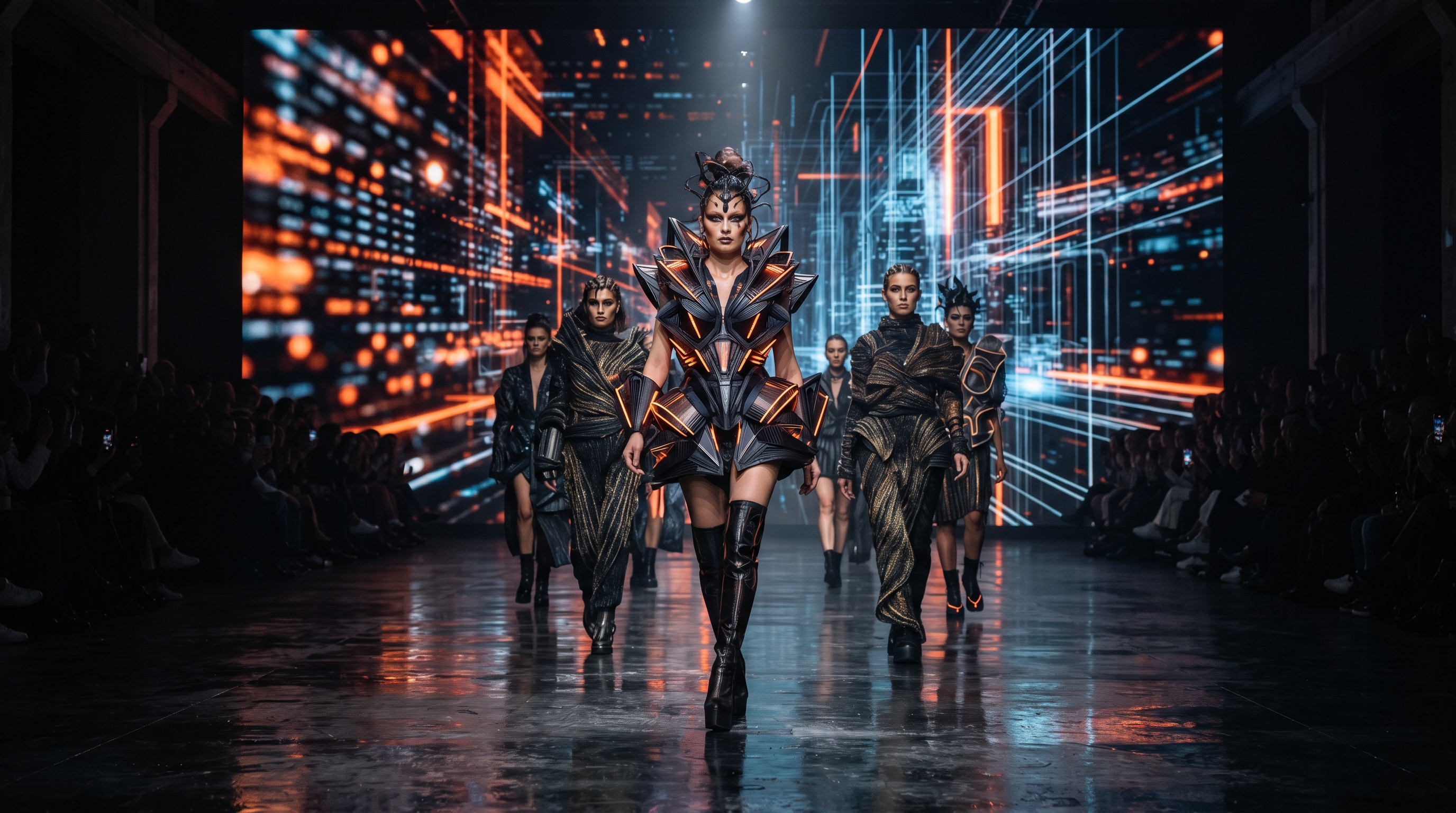
You sit down to plan the brand's next half-year and hit the same old doubt: stick with what's always worked, or test something new without knowing if it's worth the risk. The difference this year is that a big chunk of these “trends” already stopped being a gamble — it's what most of the market is already doing.
The common thread running through all of them is the same: artificial intelligence applied to fashion stopped being an experiment and became infrastructure. 73% of fashion executives already treat it as a business priority, and generative AI platforms report fashion brand sign-up growth in the range of 300% in a single quarter. Here's exactly what's changing.
1. Virtual try-on as the catalog standard, not a novelty
AI-powered virtual try-on is already an $8.5 billion market, and brands using a quality AI model convert up to 35% higher than those showing just the item on a hanger. By 2026, a catalog without a model — real or AI — already feels incomplete to most consumers.
2. Fashion video becomes the main format, not the extra
Fashion films stopped being an expensive big-brand production. With generative AI video, a 30-second ad costs up to 75% less than traditional production — opening the door for small brands to compete on equal footing on Reels and TikTok, where the algorithm already favors video over still photos.
3. Digital prototyping cuts physical samples and waste
Testing a new piece no longer requires sewing sample after sample. Digital prototyping cuts physical sample costs by 60% to 70%, meaning less discarded fabric, less rework and faster production decisions — a trend that's also pushing the industry toward a more sustainable model.
4. “Digital-first” brands stop being the exception
Industry projections show 80% of major brands will operate “digital-first” by 2028 — meaning the process starts digital (image, prototyping, market testing) and only turns into physical production at scale once validated. Brands like Zara already use generative AI to turn real model photos into entire campaigns; H&M already applies AI to forecast demand before producing.
5. Mass personalization starts becoming reality
With image and prototyping costs dropping, showing the same piece adapted to different audiences stopped being unworkable. Brands are already testing campaigns adjusted by region, season and customer profile, generating several specific versions instead of one generic image for everyone.
It's a direct extension of the same logic behind the other trends: when generating one more variation costs almost nothing, it makes sense to create the variation that speaks directly to each customer group, instead of a single image trying to please everyone at once.
- Virtual try-on and AI models as the standard, not a differentiator.
- AI-generated fashion video as the main campaign format.
- Digital prototyping replacing part of the physical sample process.
- “Digital-first” operations, with production decisions based on digital testing before the factory.
- A more diverse catalog, with more body types represented, at no extra production cost.
- Campaigns personalized by audience, without multiplying the production budget.
A trend that's already the market standard isn't a trend anymore — it's the price of admission to keep competing.
What these trends don't mean
None of them mean abandoning photographers, human models or physical production entirely. Brands still use real crews for the year's big campaign — the change is in the day-to-day volume, which is where cost and time weigh most by the end of the month.
It also doesn't mean every brand needs to adopt all five trends at the same pace. What separates whoever gets ahead from whoever falls behind isn't budget size — it's how fast they decide to test.
What to do with this in your planning
You don't need to adopt all five trends at once. Pick the one that solves your brand's most urgent pain right now — a stale catalog, high sample costs, no video — and start there. The bigger risk in 2026 isn't testing too early. It's waiting until becoming the market standard also becomes a competitive disadvantage for whoever arrives last.