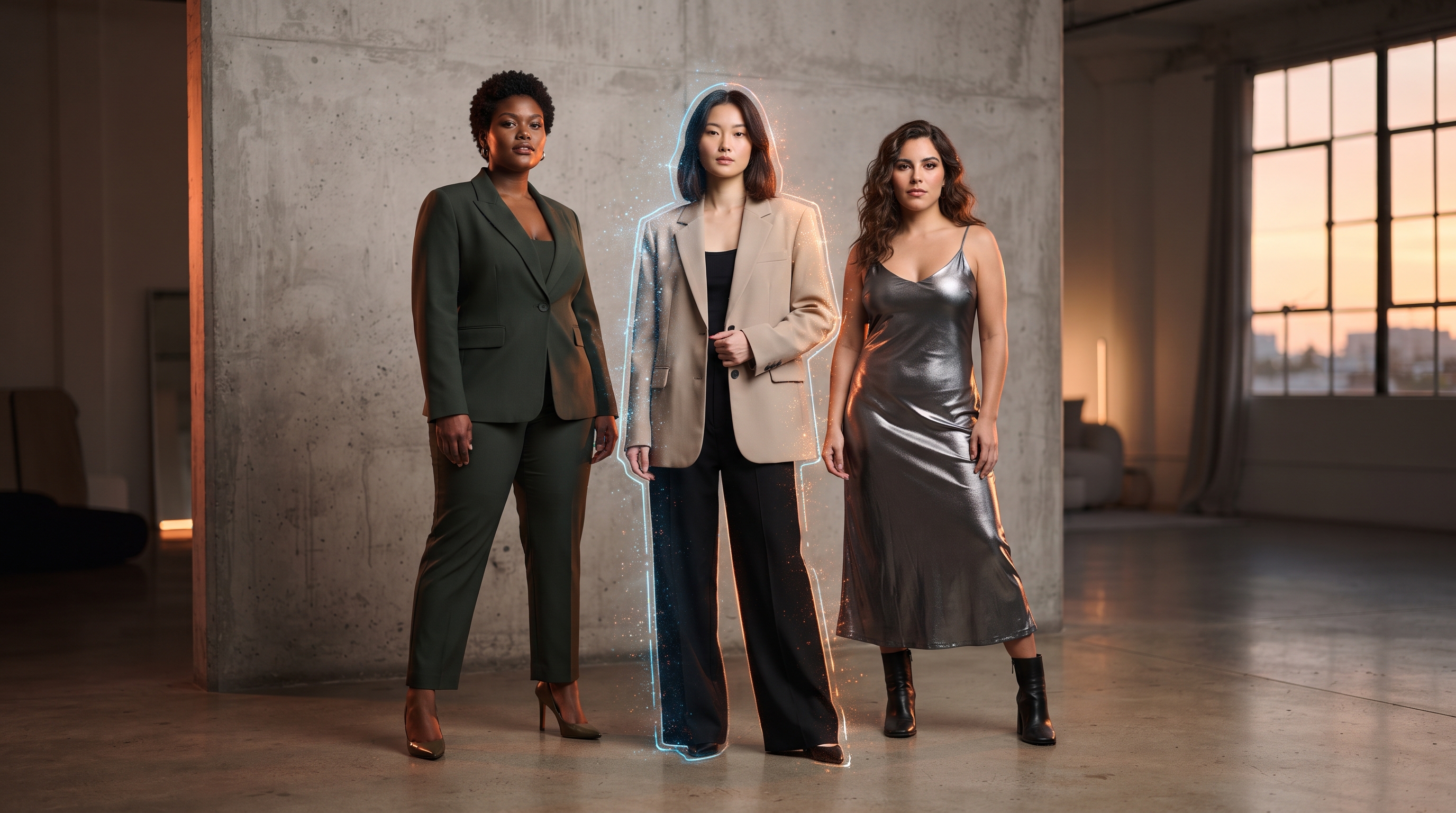
You know the scene. A customer messages you asking “will this fit me?”, “does it look good on someone with a belly?”, “won't this color look weird on my skin tone?”. You answer as best you can, explain, send another photo — and she disappears. The cart gets abandoned. It wasn't the price. It was the doubt.
That doubt has a name and a cost. In 2026, AI-powered virtual try-on is already an $8.5 billion market. Brands using a quality AI model convert up to 35% higher than those showing just the item on a hanger — and returns drop between 15% and 35% when the customer sees, before buying, how the piece actually behaves on a real body.
Why this stopped being a differentiator and became the standard
Not long ago, showing an AI model in your storefront was bold, almost an experiment only giant brands tried. Today it's the opposite: whoever still only shows the item on a hanger or mannequin is the one who looks behind. Zara, one of the biggest fashion retailers on the planet, already uses generative AI to turn real model photos into entire campaigns, cutting studio dependency without giving up a real human reference.
The reason is simple. Customers don't buy fabric, they buy the scene of how it'll look on them. A standalone product photo answers “what is this”. A model — AI or not — answers “how will this look on me”. And that second question is what decides the sale.
What changes for your bottom line once the doubt is gone
- Fewer “will this fit me” messages — the customer already saw the fit before asking.
- Fewer returns from “it didn't look like I imagined”.
- A catalog with a range of body types, without hiring a book of different models.
- Try-ons for dresses, suits or full looks with no fitting appointment needed.
- A new item live the same day the sample arrives, no waiting for a shoot date.
For anyone selling online with no physical store, this matters even more. It's the only way a customer gets any sense of fit before buying — and every doubt resolved before checkout is one fewer return showing up in the mail later.
Customers don't hesitate because the price is wrong. They hesitate because they can't picture themselves in it. Fix that, and price stops being the problem.
AI models don't take anyone's job — they remove the bottleneck in your process
The most common objection is thinking AI models replace people. In practice, what they replace is the queue: studio schedules, a physical model's book, a shoot that only happens once a month because gathering everyone on the same day costs too much. Brands still use real models for the year's big campaign — and use AI for the rest of the catalog, which is 90% of the daily work.
It's also about representing who actually buys from you. With AI models, you can show the same item on different bodies, skin tones and heights, without multiplying production cost for every variation you test.
The most common mistake when switching to AI models
The most common stumble isn't resisting the technology — it's using the wrong tool. A generic image generator doesn't know lace behaves differently from jersey, that tailoring needs a different drape, or that a print distorts when the body turns. The result looks off, and the customer notices right away, which reinforces distrust instead of solving it.
The difference between an AI model that sells and one that pushes customers away comes down to that invisible technical detail: understanding fashion, not just generating a pretty image. That's exactly why a generic AI tool and one built for people who actually sell clothes produce such different results starting from the same photo.
How to apply this without becoming hostage to an expensive agency
You don't need to hire a production house or learn visual effects software. You need a tool built for fashion — one that understands fit, fabric and styling — and turns the photo you already have into a professional model shot, in minutes, ready to post.