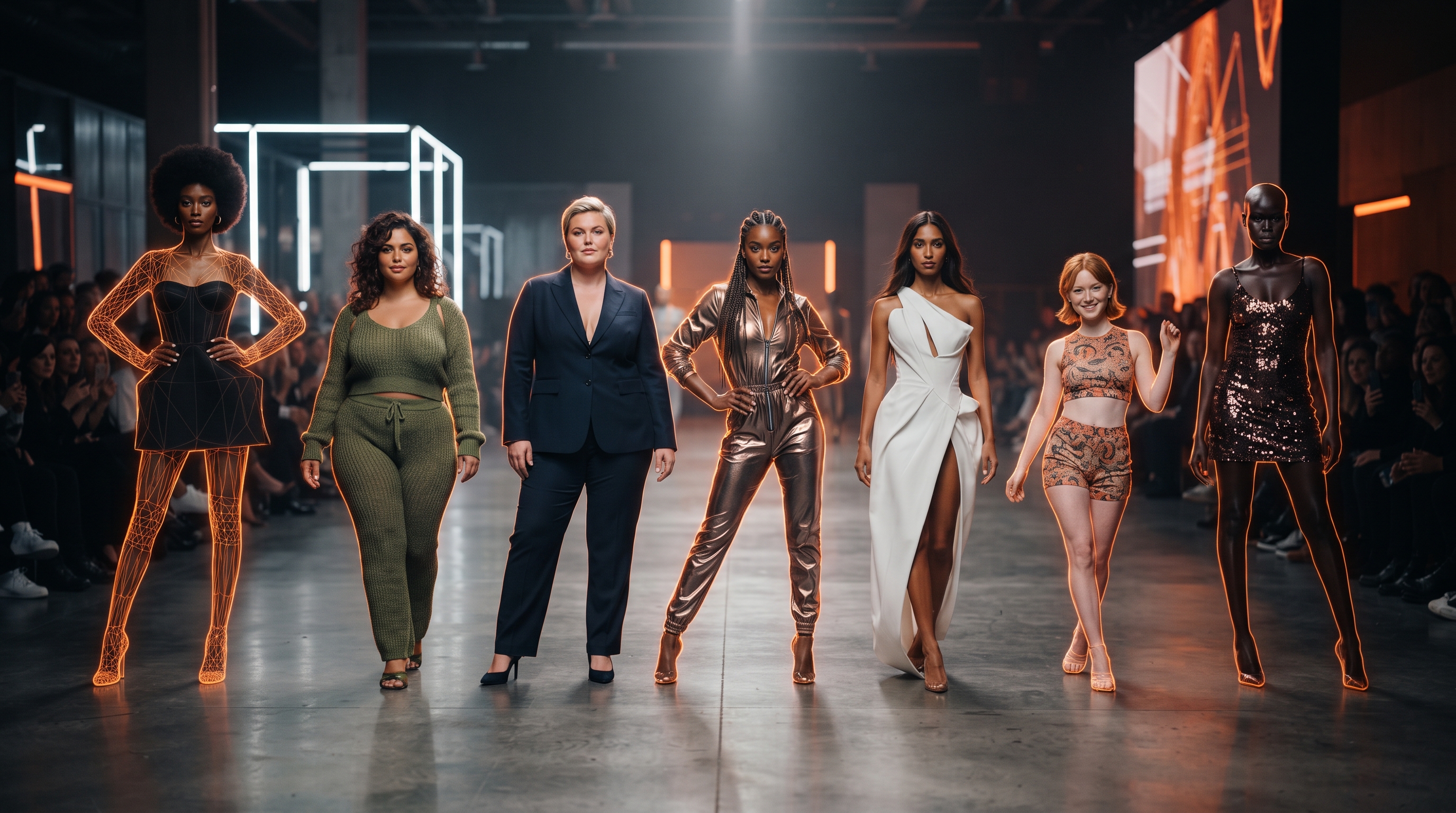
You've nailed the campaign brief, but you're stuck on something that has nothing to do with creativity: finding a model. The right size, available on the right day, for a fee that fits the budget. If the piece is plus size, the agency offers two options all month. If your audience is gender-neutral, almost none.
Meanwhile, AI virtual try-on and virtual modeling is already an $8.5 billion market — and it's not just a lab curiosity. Brands using a high-quality AI model convert up to 35% higher than those showing the piece on a mannequin or a hanger. The reason is simple: people buy what they can picture themselves wearing.
Casting that doesn't wait on anyone's calendar
Virtual Models PRO solves the slowest, most expensive part of any campaign: casting. Instead of booking, scheduling, confirming and hoping no one cancels last minute, you upload the product photo and pick who's going to wear it — right there, on screen.
It's the kind of freedom only big brands used to have: testing the same piece on different bodies, skin tones and poses, without paying a fee for every attempt and without depending on anyone else's decision.
How it actually works
The process is straightforward. You upload a clean photo of the garment on its own — well framed, nobody wearing it. Then you choose the model's gender (female, male or neutral), body type (from XS to 5XL, including maternity) and ethnicity — or leave it on "Diverse" and let the AI pick a realistic result. Finally, you choose the pose: editorial, standing, walking.
Within seconds the garment shows up worn, with fit and proportion that match the chosen body. It's fast enough to test several variations before deciding what goes into the catalog — a photo can go from a simple flat lay to a professional model shot in under 15 seconds.
The detail that actually matters
Much of the generative AI out there was trained mostly on European body types and features — which produces pretty but repetitive results, and nothing like the people who actually buy fashion. That's why it matters to use a tool built specifically for diversity of body types and ethnicities, not a generic one hastily adapted.
You don't need to convince a model to show up for your campaign. You need to convince the customer that she'll look good in that piece — and that starts with who she sees wearing it.
Who this is for
- Brands that sell extended sizes and can't find a plus-size model available this week.
- Retailers who want to test the same piece across different audiences before locking in a campaign.
- Anyone launching a new collection every week without budget for constant bookings.
- E-commerce stores losing sales because the shopper couldn't picture themselves in the flat-hanger photo.
- Brands that want a catalog with real representation, not the same model over and over.
Traditional fashion shoots run $80–$240 per image once you add up the model, photographer, studio and editing. Swapping that for virtual casting isn't about cutting quality — it's about finally having the budget to show the piece on more than one body type.
Your next campaign could have ten different models wearing the same piece — no booking, no fee, no waiting for anyone to confirm.