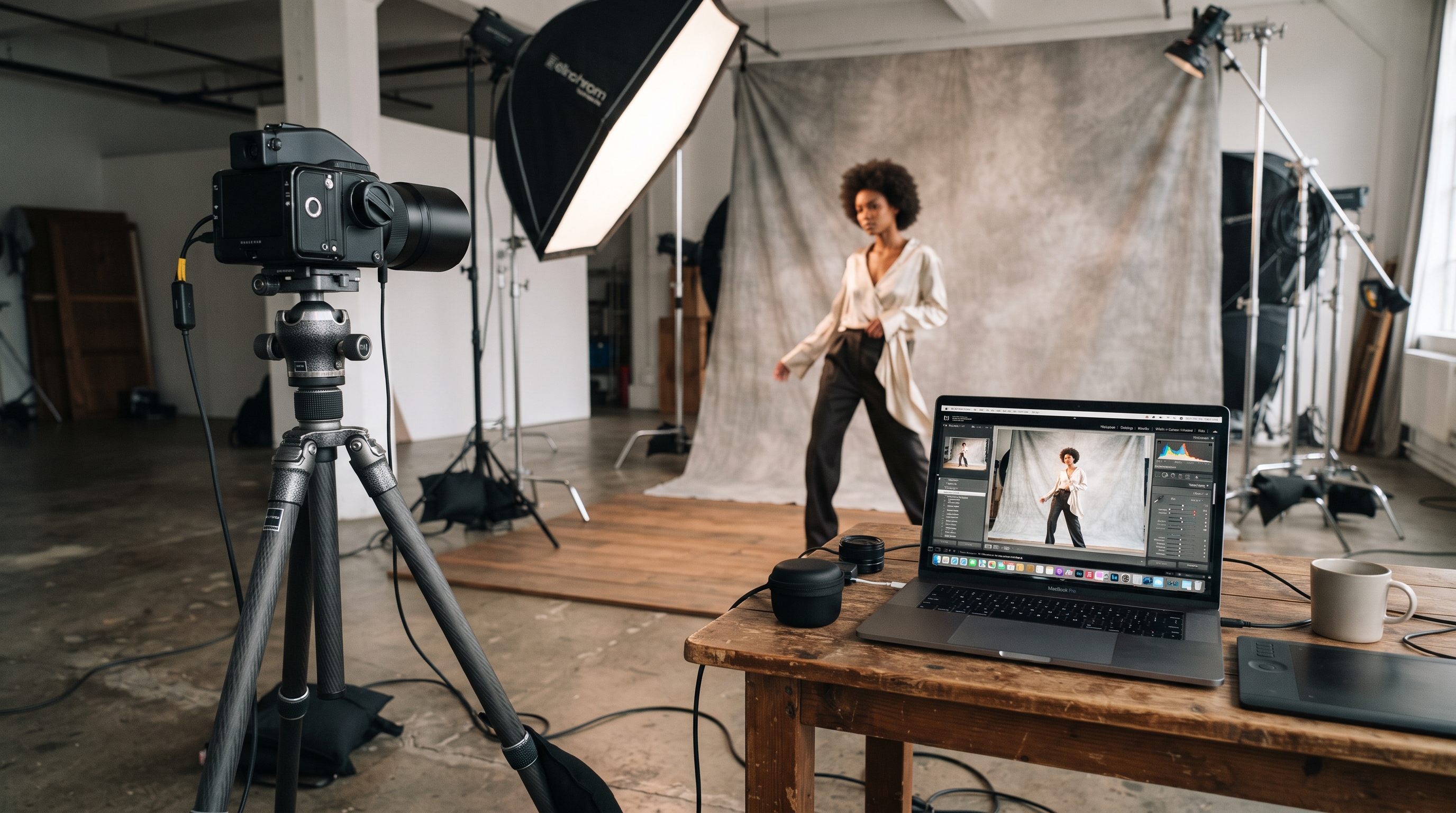
Search "fashion photographer" on LinkedIn today and you'll see the same complaint repeating itself: "AI is taking my job". That's not exaggeration or paranoia — it's a real question that deserves an honest answer, not just an AI tool's marketing saying "no, don't worry".
The same goes for models. Someone who built a career, a portfolio, an agency relationship, years of work — watching a brand generate an entire campaign without hiring anyone. It's fair to ask: where does this stop, and who loses along the way?
What's actually at stake
It matters not to treat every substitution as the same. A large fashion brand, with plenty of budget for a diverse cast and a professional photographer, swapping that for AI just to cut costs, is one situation. A small reseller who never had money to hire anyone using AI for the first time is a completely different one. The ethical debate shifts depending on who's on the other side of the trade.
This debate isn't exclusive to fashion
Illustration, voice acting, ad copywriting — several creative industries are facing the same question at the same time. Fashion isn't isolated in this challenge, and looking at how other industries are handling it helps avoid repeating the same mistakes: hiding AI use, treating replacement as inevitable without debate, or pretending the problem doesn't exist until it becomes an image crisis.
Amplifying vs. replacing — again, the heart of the matter
Industry leaders argue that AI should amplify opportunity — giving access to those who never had it — not replace people already working in that role at corporate scale just because it's cheaper. It's the same logic as the diversity debate: one thing expands who participates, the other takes the spot of someone who was already there.
Questions that separate responsible use from predatory replacement
- Did the brand already have budget and hired crew, and swap it for AI just to save money?
- Did the brand never have budget for a photographer or model, and is AI its first access to professional imagery?
- Is the brand transparent about what's AI-generated?
- Did the decision to use AI come from pure cost-cutting, or from real need for access?
- Is there any plan to keep hiring real people as the brand grows?
AI doesn't decide whether it replaces someone. The brand does — choosing to save money at the expense of people who already worked there, or to expand access for those who never had a chance.
Transparency changes everything
Whatever the brand's size, one principle doesn't change: clearly disclosing when an image is AI-generated. Hiding it isn't just an ethical problem — it's what turns a legitimate tool into something that looks like it's trying to deceive both buyers and the industry's workforce.
The reputational risk of not being transparent
A brand that hides its AI use and later gets exposed risks image damage bigger than the cost it saved. Consumers and trade press already know how to spot AI-generated imagery — and they react worse to concealment than to the use itself. That applies both to the labor-replacement debate and to diversity: transparency isn't just an ethical question, it's also protection for the brand itself.
The middle ground that's already happening
In practice, much of the market isn't picking just one side. Bigger brands keep hiring a photographer and model for the main campaign — the face of the collection, the visual identity — and use AI to scale the catalog: color variations, extra angles, an e-commerce image bank that would never have had budget for a full shoot. It's a path that preserves authored work while still solving the volume problem.
Where EstúdioLooks fits into this conversation
We're a tool built for the small brand, the reseller, the entrepreneur who never had a production budget in the first place — not to replace a photographer and model already hired by a big brand at corporate scale. The debate is real, and we won't pretend it isn't. But the answer isn't rejecting the technology — it's using it with honesty about who it's actually for.