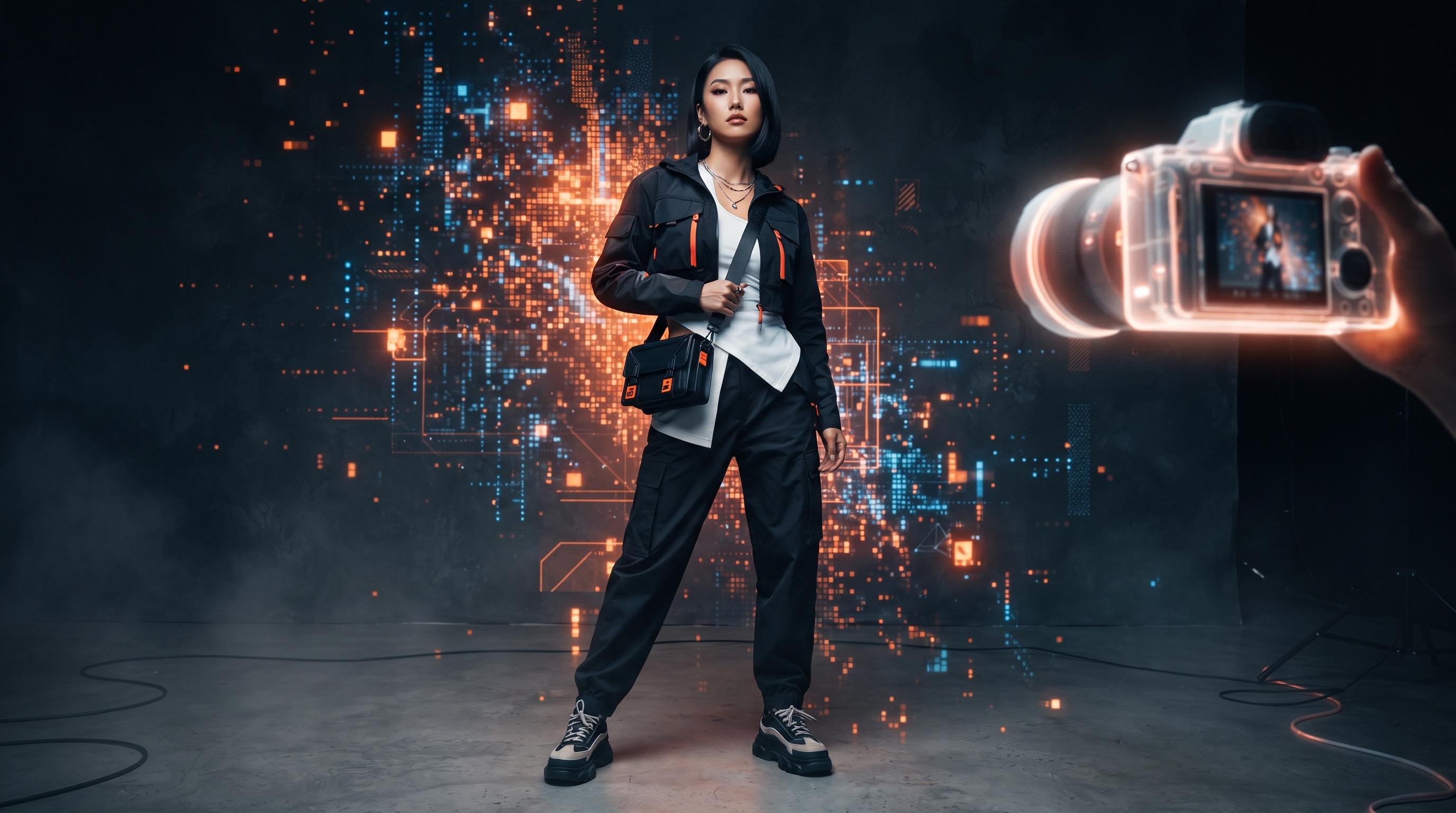
You've lived this scene before: the collection has been ready for a week, waiting on the photographer's schedule. The model cancels last minute. The studio has no slot for 12 days. And when the photo finally comes out, your competitor has already posted three full campaigns — made with a computer.
It's not just you. In 2026, 67% of the world's top 500 fashion brands already use AI-generated imagery for at least part of their catalog. And it's not just giant brands testing the tech: virtual try-on alone is now an $8.5 billion market, and shoppers who experience a high-quality AI model convert up to 35% higher than those who don't.
What exactly changed
Until recently, a professional fashion image required an entire chain of people and scheduling: photographer, model, production, styling, studio, retouching. Every link in that chain is a delay and a cost — traditional shoots run $80–$240 per image once you count crew, models, space and editing.
Generative AI broke that chain. Today you can upload a single product photo — even shot on a phone — and turn it into an editorial image, complete with model, scenery and styling, in minutes. Brands like Zara already use generative AI to speed up entire campaigns starting from real product photos.
Signs your brand should have already switched
- You postpone posts waiting for a photographer's open slot.
- Your feed has 3 great photos and the rest are phone shots on a bed.
- You've already lost a sale because the product photo didn't convince.
- Your direct competitor is posting more, with a pricier-looking visual than yours.
- You calculate shoot costs before deciding to launch a new piece.
The question isn't “does AI replace the photographer?” anymore. It's “how much longer will your brand keep waiting for one while the competition has already sold out.”
What this means if you sell fashion online
For small stores and resellers, the effect is even more direct. Recent research shows small entrepreneurs already using AI tools to turn a bed-photo of a garment into a model shot — no studio budget, no crew. It's the democratization of a resource that, until recently, only big brands could afford.
The practical outcome: up to 90% lower visual production cost, campaigns launched in hours instead of weeks, and a catalog that's always fresh — without depending on anyone else's schedule.
What to do with this now
You don't need to become an AI expert. You need a tool built for fashion — one that understands fabric, fit and styling, not just "generate a pretty picture". That's exactly the difference between a generic AI tool and one made for people who actually sell clothes.