Everyone's talking about generative AI in fashion, but the moment you try to figure out where to start, it turns into alphabet soup: diffusion model, prompt, upscaling, fine-tuning. You close the tab and go back to what you already know how to do — while the market around you keeps moving.
That delay has a real cost. 73% of fashion executives already consider generative AI a business priority, not a curiosity experiment. And industry projections show 80% of major brands will operate a “digital-first” model by 2028 — meaning digital stops being a support channel and becomes the main engine of the operation.
What generative AI in fashion actually is, no jargon
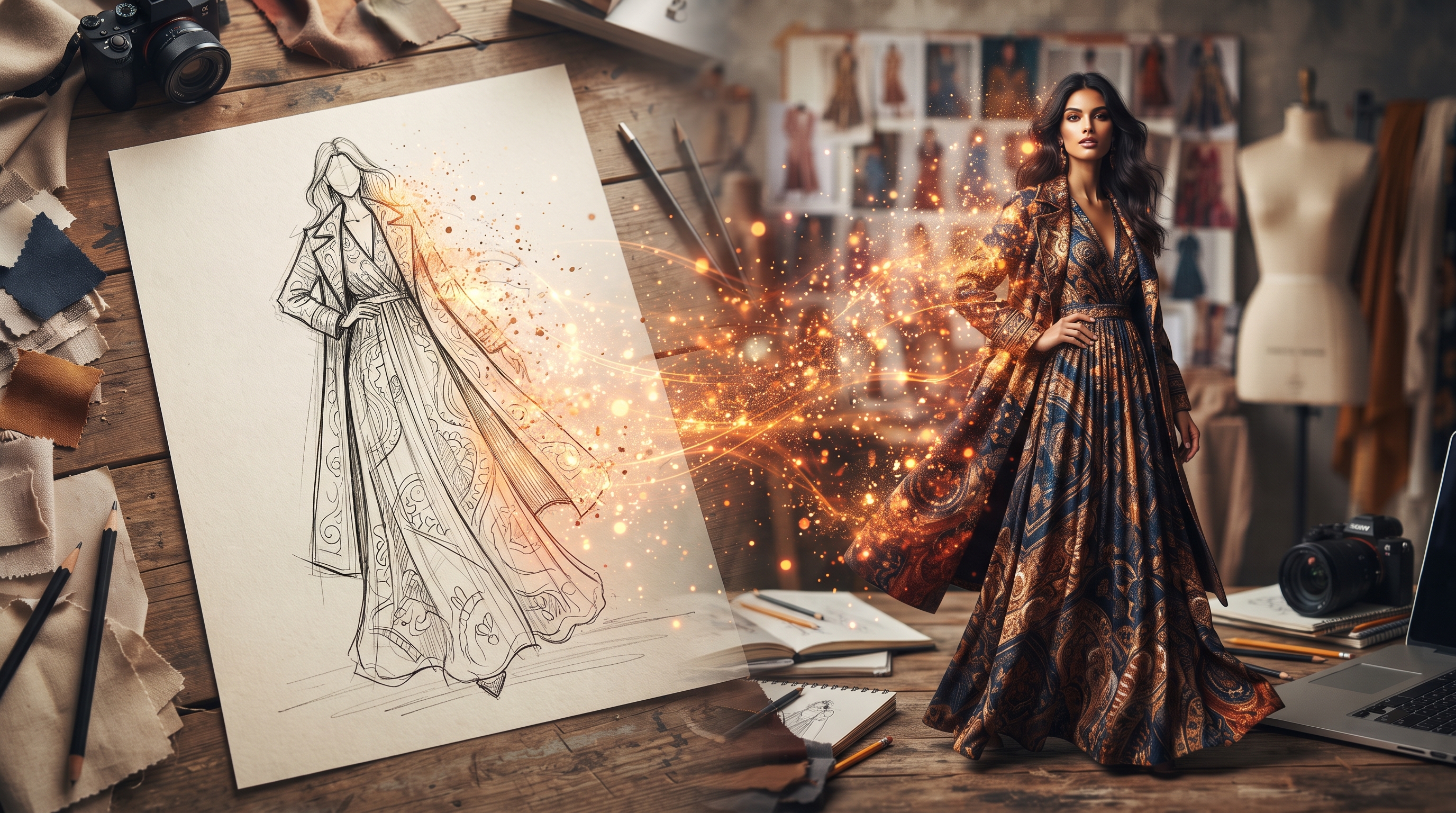
It's simple: you show it an image (a product photo, say) and an AI system generates a new image — or video — from it, following instructions you give. In fashion, that turns into a model wearing the piece, a new scene, a different print, video with motion, all starting from the same source photo.
Is this the same as ChatGPT or Midjourney?
Not exactly. General-purpose AI tools generate pretty images, but they don't understand fashion's specifics — how lace falls differently from denim, how a print behaves on a fold, how a body moves inside a tailored piece. For fashion, a generic tool's output usually comes out “almost right”, which in practice means wrong enough for the customer to notice.
That's why fashion-specialized tools are gaining ground fast: they start from the same type of technology, but are trained and tuned specifically to understand fabric, fit and styling — the difference that decides whether an image looks professional or just “AI-generated”.
Where generative AI is already being used for real
- Turning a product photo into an editorial image with a model and scenery.
- Virtual try-on, showing a piece on different bodies and body types.
- Digital prototyping of new pieces before producing a physical sample.
- Demand forecasting — H&M already uses AI to predict what will sell more.
- Creating and testing prints before approving textile production.
- Fashion video generated from a still photo, with no traditional filming.
The question isn't whether your brand will use generative AI anymore. It's whether it learns to use it before the competition figures it out first.
How much this actually saves
The most concrete number for whoever decides the budget: digital prototyping cuts physical sample costs by 60% to 70%. That means testing more variations of a new piece — color, fabric, cut — without paying to physically sew every sample before knowing if it's worth producing at scale.
Add that to lower image and campaign video costs, and the effect isn't just a one-off saving: it frees up budget currently locked in repetitive production so you can invest in the things only humans do well — brand strategy, service, customer relationships.
How to start without getting lost: step by step
- Pick one concrete problem to solve first — don't try to solve everything at once. A stale catalog photo is a good place to start.
- Use photos you already have of the product. You don't need to reshoot anything to start testing.
- Test on lower-risk pieces before applying it to the whole collection — validate results with your actual audience.
- Measure what changes: production time, engagement, conversion, returns.
- Scale to more pieces and formats (photo, video, print) only after the first test proves the value.
Is this expensive for someone just starting out?
It doesn't have to be. Generative AI tools built for fashion charge per use or an affordable monthly plan — quite different from the investment of a traditional photo shoot or hiring a whole video crew. You can test with just a few pieces before deciding if it's worth expanding to the whole catalog.
Waiting to test also has a cost, just an invisible one: while you decide, the competition is already learning from actual use — testing what works, adjusting what doesn't. That accumulated learning is an advantage that gets harder to catch up on the longer it goes on.
You don't need to become a technical expert
The most common mistake is thinking you need to understand the technology to use generative AI. You don't. You need a tool built for people who work in fashion day to day — one that already handles the “how” so you can focus on the “what”.