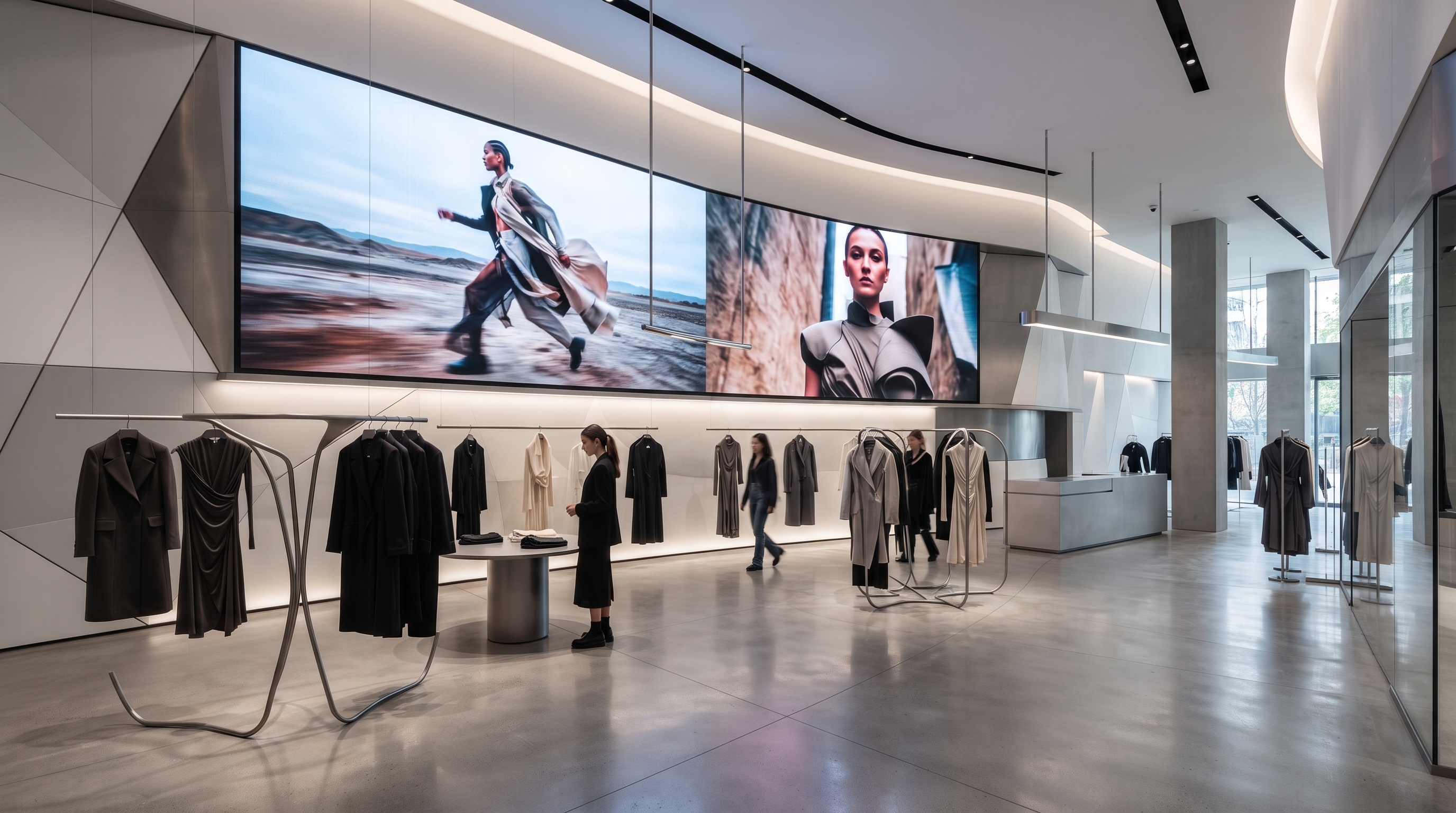
While much of the market is still debating whether "AI is worth testing", Zara and H&M moved past that stage a while ago — and it's no secret, it's declared strategy.
Zara already uses generative AI to create fashion images from real model photos, speeding up production of entire campaigns. H&M uses AI for demand forecasting and inventory optimization — deciding what to produce, how much, and where, before a single physical piece is made. Neither of them is "testing" anymore. They're in production, every day.
What big brands are already doing today
At Zara, the process starts with a real photo of a model or product — and from there, generative AI creates complete editorial variations, with scenery and styling, in a fraction of the time a traditional shoot would take. At H&M, the use is different but equally strategic: demand-forecasting algorithms decide how much of each piece to produce, cutting both excess inventory and stockouts in stores.
Why this goes beyond "saving money"
Cutting costs is just the visible part. The real reason behind the adoption is response speed: launching a collection in days instead of months, testing visuals before committing to physical production, and personalizing campaigns per market without multiplying the production budget proportionally.
What this costs in concrete numbers
A traditional fashion campaign with a photographer, model, production and studio easily runs past $4,000 per session for mid-size productions — and that's before counting the scheduling time, which usually takes weeks. Generating the same volume of images with AI costs a fraction of that and takes hours, not weeks. It's that combination of cost and speed — not just one of the two — that made Zara and H&M treat this as a strategic priority, not an innovation experiment.
The pressure also comes from consumers, not just competitors
Social media changed the pace consumers expect from a brand. A trend that goes viral today can lose relevance in a matter of weeks — and waiting months for a photoshoot means missing the right moment to sell. Brands that are already digital-first aren't just copying Zara; they're responding to the same pace consumers themselves have set.
Signs the market has already gone digital-first
- A giant brand already uses generative AI in a real part of its image production — not just as an isolated innovation pilot.
- Inventory decisions increasingly driven by algorithmic forecasting, not just buyer intuition.
- Launch speed has become as important a competitive edge as price.
- Consumers barely notice — or don't care — that part of the catalog is AI-generated or AI-assisted.
- Industry projections point to most big brands becoming digital-first by 2028.
Zara and H&M aren't betting on AI. They've already changed the process. The question left for the rest of the market is whether it gets there by choice or by catching up.
Digital-first is bigger than just images — but it starts there
The digital-first movement also includes virtual showrooms, 3D sample fitting before producing a physical piece, and collections that are born and live purely digitally before any manufacturing decision. EstúdioLooks focuses specifically on the image generation and styling part — the most accessible entry point into this movement for anyone who doesn't yet have full 3D infrastructure, but can already compete on campaign speed and visuals.
What this means if you're not a giant
A small brand doesn't have the budget for an in-house AI lab like a multinational's. But the technology behind this shift — image generation, virtual models, testing product variations before producing — is already available through an accessible tool, with no need to hire a data team or an innovation department.
The gap between big and small brands is stopping being about access to technology, and becoming just a matter of operation size.