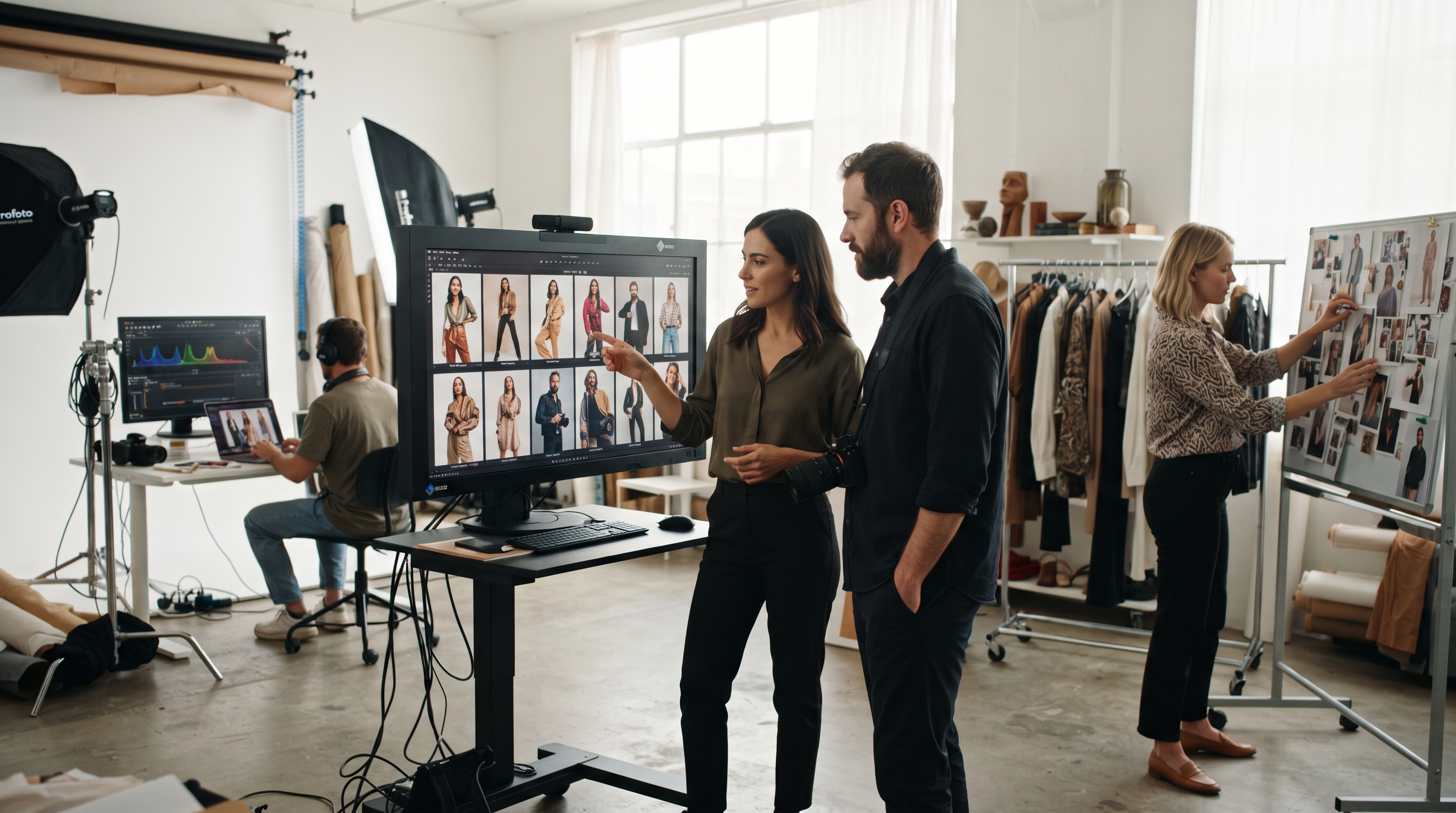
Your brand grew, the catalog doubled, and the first idea that comes up is “I need to hire more people to keep up with visual content”. Before opening a job posting, it's worth asking: is it people you're missing, or is it process? Often the problem isn't a lack of talent on the team — it's the production model the team uses.
For most fashion brands, the real bottleneck is that every image still depends on a photographer, a model, a studio and someone else's schedule. Scaling that model the traditional way means multiplying cost and turnaround with every new piece you launch. There's another path — and it's already being used by the competitor launching faster than you.
Why “hire more people” doesn't really scale
Doubling your visual production the traditional way means doubling the cost: another photographer, more shoots to schedule, more people to coordinate, more alignment meetings. And even then, the physical limit stays the same — each person only produces a finite volume of images per day, no matter how many roles you open or how much budget you throw at it.
Hiring also has costs beyond salary: recruiting, training, tools, management. And even after all that, the new hire still depends on the same chain of photographer, model and studio to produce an image — the bottleneck just moves, it doesn't disappear.
While your brand is calculating the cost of a new hire, your direct competitor might be launching triple the pieces with the same size team — because their bottleneck stopped being photography. They traded “more people” for “more tooling”.
What changes with AI-powered visual production
With a specialized fashion AI tool, one person alone can produce the visual volume of an entire production team — without a proportional cost of scale. A piece goes from a simple product photo, even shot on a phone, to a complete campaign with model, scenery and styling, in minutes instead of weeks.
That means the same person who today coordinates a photoshoot can, alone, generate the visual material for new pieces, color variations and campaign tests — all on the same day, without waiting on anyone.
Signs your brand should have already scaled this way
Some signs show up before any formal decision to hire. If more than one of these sounds familiar, your brand has already gone past the point of just “surviving” current volume.
- You postpone launching new pieces because you don't have anyone to shoot the photo.
- The content team already works at full capacity, and the catalog is still growing.
- You've already calculated how much it would cost to hire another photographer or producer.
- Your competitor launches more pieces per week with a team the same size as yours.
Scaling visual production isn't the same as hiring more people — it's the same as removing other people's schedules from your path.
How this works in practice
The process trades “schedule and wait” for “upload and generate”: you photograph the product — even without a studio, even with a phone — upload the image to the tool, and get back the product dressed on a model, with adjustable scenery and styling. Repeat this for every new piece, without depending on anyone but yourself.
The direct result: brands that adopt this model report an average 340% faster launch speed and up to 90% lower visual production costs — meaning real catalog growth without proportional team growth.
When it makes sense to scale this way
If your brand already feels the friction of “more pieces, same team”, that's the signal it's time. The question isn't whether you can scale without hiring anymore — it's how much longer your brand will keep operating the old way while the competition has already scaled its catalog without spending an extra cent on headcount.